Our History: The Story of St. Patrick Parish
St. Patrick Parish was established on June 3, 1915 at the request of Archbishop Edmond Prendergast of Philadelphia. The first pastor was Father John H. Martin, who was sent to Malvern in 1915 by Archbishop Prendergast and remained at St. Pat’s until 1930.
Soon after its founding, the parish purchased houses and property on Channing Avenue and Roberts Lane and began plans to build a “proper Catholic Church”. The rectory was originally built in the early 1870’s by David Evans, a Quaker businessman, surveyor, teacher and farmer. With the support of its fifty member families, as well as its faithful summer residents, prominent Philadelphia families such as the Hardarts and the Kellys, who summered in the ‘countryside’ of Malvern, St. Patrick Church was completed and dedicated on November 11, 1917.
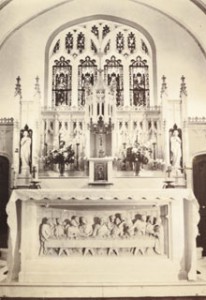 The new church was heralded nationwide for its beauty and design, which is an adaptation of a fifteenth century English Gothic country church. Photographs of the specially designed altars, stained glass windows, full equipped auditorium in the basement, green tile roof, copper gutters and Estey pipe organ were featured in major architectural reviews throughout the United States.
By the mid-1950’s, St. Patrick Parish saw the need for a parish school. On March 17, 1954, Father Martin’s successor, Father James Devers, officiated at the ground breaking ceremony for the four room brick school that was staffed by the Sisters of St. Joseph. On that property was the home originally owned by William Penn Evans, nephew of David Evans, which subsequently served as St. Patrick’s first convent and school.
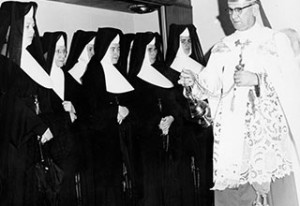 A second building was completed in 1965 and dedicated by Father John Barron, who had succeeded Father Devers in 1956. During this time of growth, the parish purchased a home on Channing Avenue and remodeled the brick structure for use as a convent. In 1983, after almost sixty years of service to the parish, the Sisters of St. Joseph were reassigned to other work.
In 1970, Father Barron was succeeded by Father Francis McDevitt, who saw this small country parish blossom into a parish community of over 1200 families. Father McDevitt was succeeded, in 1986, by Father Francis Menna, who was first an administrator and then appointed pastor, in 1987. Father Menna, acting on the parish’s response to the growing need for space, purchased property on Woodland Avenue, in 1988.
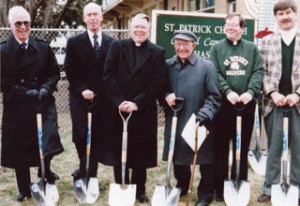 After being appointed Vicar for Delaware County, in July of 1989, Father Menna was succeeded by Father James J. Ambrogi, who took on the responsibility of seeing the parish of St. Patrick grow into the next century. Nicknamed ‘the Builder’, Father Ambrogi pioneered the expansion of the church structure, doubling the seating capacity, while preserving the original stained glass windows. The new church has fully self-contained Kindergarten and First Grade classrooms, library and cafeteria that also serve the Religious Education Program. He also enlarged the school, adding a gym, and constructed a new church rectory.
In 2011, after twenty-two years of faithful service, Father Ambrogi retired and was succeeded by our current pastor, Father Christopher Redcay, former Pastor of Our Lady of Ransom Parish in Philadelphia. Father Redcay brings a fresh perspective to the St. Patrick Community, a commitment to enriching the spirituality and faith understanding of all members, particularly in the face of liturgical changes. Known for bringing vibrancy and change to his assignments, Father Redcay is driven to expanding and deepening parish programs and faith formation efforts.
St. Patrick Parish now numbers over 2600 families in an area of twenty-seven square miles. We are characterized by high-growth, with twice as many children from infancy to six years old than from ages seven to eighteen. Our parish vows to be an ever-evolving and improving faith community, moving into the future with God’s grace, listening to and satisfying the spiritual needs of all members.